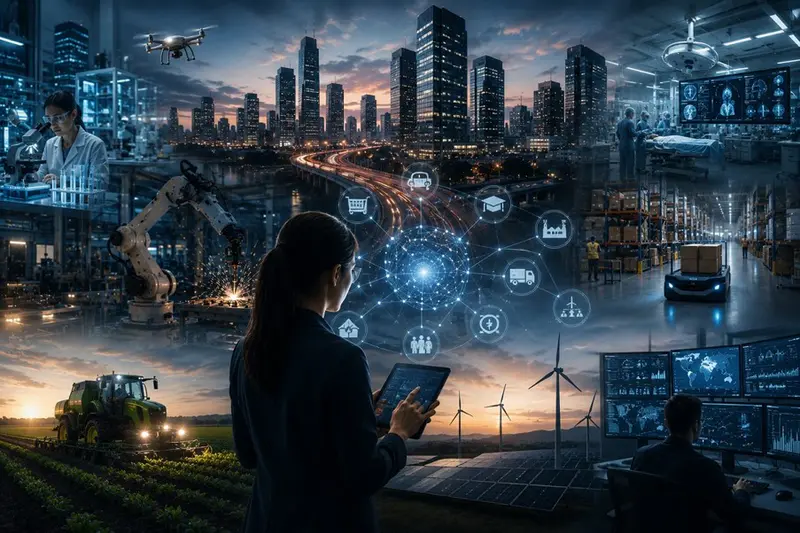
For more than a decade, Industry 4.0 has transformed manufacturing through automation, connected devices, artificial intelligence (AI), robotics, cloud computing, and industrial Internet of Things (IIoT) technologies. While these innovations significantly improved efficiency and productivity, industrial strategy is now evolving toward a broader objective.
Increasingly referred to as Industry 5.0, this next phase places equal emphasis on human expertise, sustainability, and resilience alongside technological advancement. Rather than viewing automation as a replacement for people, Industry 5.0 focuses on collaboration between intelligent technologies and skilled workers to create more adaptive, sustainable, and innovative industrial ecosystems.
The European Commission describes Industry 5.0 as an approach that goes beyond productivity alone by placing worker well-being, sustainability, and resilience at the center of industrial transformation. (Research and innovation)
This report explores how Industry 5.0 is influencing manufacturing, supply chains, industrial technology, workforce development, and long-term business competitiveness.
Industrial innovation has historically progressed through successive technological revolutions.
Recent decades have seen widespread adoption of:
Industrial automation
Robotics
Cloud computing
Artificial intelligence
Digital twins
Industrial IoT
Advanced analytics
While these technologies remain central to industrial competitiveness, organizations increasingly recognize that long-term success depends not only on automation but also on adaptability, sustainability, and human collaboration.
Industry 5.0 reflects this broader vision.
Understanding Industry 5.0
Industry 5.0 builds upon the digital foundations established by Industry 4.0 while expanding industrial priorities.
Rather than focusing exclusively on operational efficiency, Industry 5.0 emphasizes three interconnected objectives:
Human-centricity
Sustainability
Resilience
According to the European Commission, Industry 5.0 complements Industry 4.0 by ensuring that research and innovation contribute to industrial systems that benefit workers, society, and the environment alongside economic performance. (Research and innovation)
Human-Centered Innovation
One of the defining characteristics of Industry 5.0 is the changing relationship between people and technology.
Instead of replacing workers, intelligent systems increasingly support human expertise.
Examples include:
Collaborative robots (cobots)
AI-assisted decision support
Digital work instructions
Augmented reality guidance
Intelligent safety monitoring
Technology increasingly augments human capabilities while allowing employees to focus on higher-value activities.
Artificial Intelligence as an Industrial Enabler
Artificial intelligence has become a foundational technology across industrial operations.
Current applications include:
Predictive Maintenance
AI identifies equipment issues before failures occur.
Quality Inspection
Computer vision systems improve manufacturing consistency.
Production Optimization
Machine learning continuously adjusts production parameters.
Demand Forecasting
AI improves production planning using historical and real-time information.
Recent academic reviews note that trustworthy AI is becoming central to Industry 5.0 by supporting sustainable, resilient, and human-centric industrial operations. (arXiv)
Digital Twins Improve Industrial Visibility
Digital twins create virtual representations of physical assets.
Industrial organizations increasingly use digital twins for:
Equipment monitoring
Factory simulation
Production optimization
Maintenance planning
Energy management
These virtual environments allow organizations to evaluate operational changes before implementing them in physical facilities.
Sustainability Is Becoming a Core Objective
Environmental performance has become an important component of industrial innovation.
Organizations increasingly invest in:
Energy-efficient production
Circular manufacturing
Waste reduction
Resource optimization
Carbon monitoring
The European Commission identifies sustainability as one of the three foundational pillars of Industry 5.0 alongside resilience and human-centricity. (Research and innovation)
Building More Resilient Industries
Recent global disruptions have highlighted the importance of resilient industrial systems.
Manufacturers increasingly strengthen resilience through:
Supply chain diversification
Real-time monitoring
Predictive analytics
Flexible manufacturing
Cloud-based industrial systems
Industry 5.0 encourages organizations to design production systems capable of adapting more effectively to changing market conditions.
Workforce Development Becomes Strategic
As industrial technologies become more sophisticated, workforce capabilities become increasingly valuable.
Organizations continue investing in:
Digital skills
AI literacy
Robotics training
Data analytics
Continuous learning
Human-machine collaboration
The Industry 5.0 framework highlights workforce development as an important element of industrial competitiveness. (Research and innovation)
Smart Factories Continue to Evolve
Modern smart factories increasingly combine:
Industrial IoT
Artificial intelligence
Cloud computing
Robotics
Edge computing
Advanced sensors
Rather than maximizing automation alone, next-generation smart factories increasingly seek to improve flexibility, customization, worker experience, and sustainability.
A 2025 systematic review of smart factory production highlights that human-centricity is emerging as one of the defining characteristics of Industry 5.0 manufacturing environments. (arXiv)
Cybersecurity Remains Essential
Greater industrial connectivity increases the importance of cybersecurity.
Organizations continue strengthening:
Industrial network protection
Identity management
Operational technology (OT) security
Secure remote access
Continuous monitoring
Reliable cybersecurity supports operational continuity while protecting increasingly connected production environments.
Challenges Facing Industry 5.0
Despite significant progress, several implementation challenges remain.
These include:
Legacy industrial infrastructure
Skills shortages
Technology integration
Cybersecurity risks
Investment requirements
Organizational change management
Addressing these challenges requires coordinated investment in both technology and workforce development.
Emerging Trends
Several developments are expected to shape Industry 5.0 over the coming years.
Greater Human-Machine Collaboration
Collaborative robotics and AI decision-support systems are expected to become more widely deployed.
Intelligent Manufacturing
Factories will increasingly optimize production using real-time analytics and adaptive automation.
Sustainable Industrial Design
Manufacturers are expected to continue integrating circular economy principles and resource-efficient production.
Digital Workforce Development
Organizations will likely invest further in digital upskilling and continuous workforce education.
Trustworthy Artificial Intelligence
Industrial AI adoption is expected to place increasing emphasis on transparency, governance, explainability, and responsible deployment. (arXiv)
Conclusion
Industry 5.0 represents an evolution in industrial innovation that extends beyond automation and digital transformation. By combining advanced technologies with human expertise, sustainability objectives, and resilient operational design, organizations are redefining what successful industrial transformation looks like.
Artificial intelligence, digital twins, collaborative robotics, predictive analytics, and intelligent manufacturing systems will continue driving productivity. However, long-term competitiveness is increasingly expected to depend on balancing technological capability with workforce development, responsible innovation, and environmental stewardship.
As industries continue modernizing, Industry 5.0 offers a framework for creating manufacturing systems that are not only smarter, but also more adaptable, sustainable, and centered on human value.
Frequently Asked Questions (FAQs)
What is Industry 5.0?
Industry 5.0 is an industrial innovation model that combines advanced technologies with human-centered design, sustainability, and operational resilience to complement the Industry 4.0 approach. (Research and innovation)
How is Industry 5.0 different from Industry 4.0?
While Industry 4.0 primarily emphasizes automation, connectivity, and digital transformation, Industry 5.0 expands the focus to include worker well-being, sustainability, resilience, and collaboration between people and intelligent technologies. (Research and innovation)
What technologies support Industry 5.0?
Key technologies include artificial intelligence, collaborative robots, digital twins, industrial IoT, cloud computing, edge computing, advanced analytics, and machine learning.
Why is human-machine collaboration important?
Human expertise provides creativity, judgment, and adaptability, while intelligent technologies enhance productivity, safety, and operational efficiency.
Why is sustainability central to Industry 5.0?
Industry 5.0 encourages industrial systems that improve resource efficiency, reduce environmental impact, strengthen resilience, and create long-term value for businesses, workers, and society. (Research and innovation)
References
European Commission.Industry 5.0 – Research and Innovation.
https://research-and-innovation.ec.europa.eu/research-area/industrial-research-and-innovation/industry-50_en (Research and innovation)European Commission.Industry 5.0: Towards a Sustainable, Human-Centric and Resilient European Industry.
https://research-and-innovation.ec.europa.eu/knowledge-publications-tools-and-data/publications/all-publications/industry-50-towards-sustainable-human-centric-and-resilient-european-industry_en (Research and innovation)European Commission.Industrial Technologies Roadmap on Human-Centric Research and Innovation for the Manufacturing Sector (2024).
https://research-and-innovation.ec.europa.eu/knowledge-publications-tools-and-data/publications/all-publications/industrial-technologies-roadmap-human-centric-research-and-innovation-manufacturing-sector_en (Research and innovation)Vyhmeister, E. & Castañé, G.When Industry Meets Trustworthy AI: A Systematic Review of AI for Industry 5.0. arXiv (2024).
https://arxiv.org/abs/2403.03061 (arXiv)
Movahed, A. B., Nozari, H., & Movahed, A. B.Systematic Review of Smart Factories Production in Industry 5.0. arXiv (2025).
https://arxiv.org/abs/2504.21525 (arXiv)