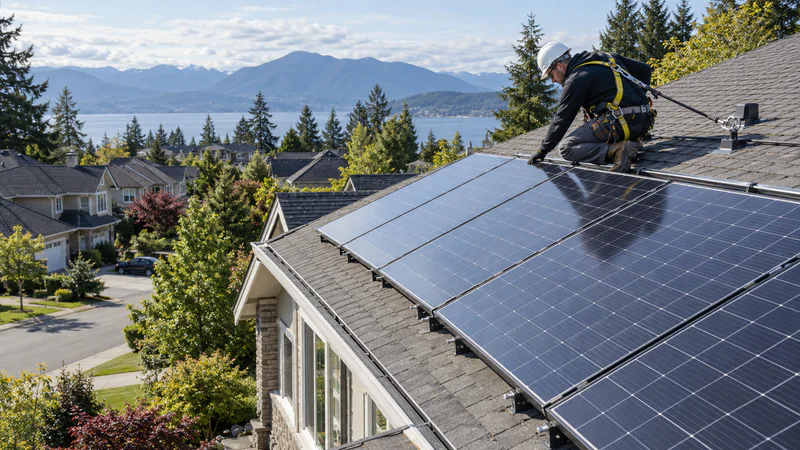
Residential solar offers Canadian homeowners a way to generate part of their electricity on site. Whether an installation delivers a financial benefit depends on the property, upfront cost, financing and local electricity arrangements. Northern PWR presents its approach as combining a household-specific design with support through installation and activation.
Northern PWR website lists Alberta, British Columbia, Manitoba and Saskatchewan as its service locations. Its published process describes an assessment of the home, a tailored proposal, permitting and installation. These services address practical steps in adopting solar, from assessing the property to coordinating the work needed to bring a system into operation.
Residential Solar in Canada
Canada’s solar potential varies by location. Natural Resources Canada explains that potential is generally higher in central regions and lower in cloudier coastal areas. Conditions at an individual property still matter: roof orientation, shading, available space and seasonal sunlight influence expected generation.
Northern PWR’s installation materials describe checking roof condition, electrical capacity and historical energy consumption. Assessing these factors can help determine an appropriate system size. A household should also consider whether roof repairs are needed before panels are fitted and whether its electricity use is likely to change.
Generating electricity can reduce purchases from the grid, but a lower energy bill is not the same as a net financial saving. The calculation should include the installation price, borrowing costs where applicable, ongoing expenses and any charges that remain on the utility bill. Expected payback should be presented as an estimate based on stated assumptions.
Project Communication and Community Engagement
Northern PWR maintains company profiles on LinkedIn, Facebook and Instagram. Such channels give prospective customers a way to follow the company’s public updates and ask questions about its work. Company posts and customer testimonials should be distinguished from independently assessed installation performance.
The practical value of project examples is in the information they provide. A useful case study would identify system capacity, the property’s electricity needs and measured production over a stated period. Roof area alone does not show how much electricity an array generates or what proportion of a bill it can offset.
Different homes may require different designs. A smaller array may offset only part of a household’s electricity consumption, while a larger array may be appropriate where consumption and connection rules support it. The choice should follow the site assessment rather than an assumption that a larger installation necessarily offers better value.
The Installation Process for Homeowners
According to Northern PWR’s published installation process, its work includes a proposal, site survey, design and approvals, installation, and inspection before activation. The company estimates four to six weeks for design and approvals and one to two days for physical installation. These are company estimates, rather than guaranteed completion dates or the full time from enquiry to operation.
The distinction matters because completing the physical installation does not necessarily authorise the system to export electricity. Northern PWR describes local and utility inspections before activation. Scheduling, property conditions and utility requirements can affect when a system becomes operational.
The Alberta Utilities Commission similarly explains that project timing depends on application review, interconnection studies and meter installation. Its guidance also says micro-generation systems are intended to meet all or part of the customer’s annual electricity needs. These Alberta requirements should not be assumed to apply identically in other provinces.
Before signing, homeowners should understand which tasks the installer will handle, what is excluded from the quotation and who is responsible for the utility application. A written agreement should identify the equipment, payment schedule, estimated production, warranty coverage and any conditions attached to performance commitments.
Understanding the Reported Impact
Northern PWR’s homepage reports 51.55 megawatts of installed solar capacity. This is a company-reported figure, not an independently audited total presented in this article. Installed capacity indicates the rated power of equipment; it does not by itself establish annual electricity production, household savings or avoided emissions.
The environmental and financial results of a solar project require separate calculations. Output depends on site conditions and equipment performance. Avoided emissions depend partly on the electricity displaced, while financial savings depend on the household’s tariff, export arrangements and costs. A company-wide total should therefore not be treated as a prediction for an individual home.
How a Residential Solar System Works
Northern PWR’s Solar 101 resource describes panels, inverters, mounting hardware and monitoring technology. Panels generate direct-current electricity, and an inverter converts it into alternating current for household use. Depending on the configuration, generated electricity can be used in the home, stored in a battery or exported to the grid.
Measurement Canada explains that net metering measures electricity supplied from the grid and electricity sent back to it. Programs and rates vary by province and territory. Homeowners should confirm the current rules with their utility, including how exports are valued and whether credits expire.
In Alberta, the Utilities Commission notes that customers continue to receive bills after installing micro-generation, including applicable transmission, distribution and other charges. This is why solar should not be described as automatically eliminating utility costs. The value of electricity used directly in the home may also differ from that of electricity exported.
Solar panels alone do not necessarily provide backup electricity. BC Hydro’s outage guidance explains that most self-generation systems shut down during a grid outage for safety. Backup capability depends on a suitable system configuration; even a battery does not guarantee uninterrupted power for every appliance.
Monitoring Maintenance and Support
Monitoring can help a homeowner compare production with expectations and identify changes that need attention. It does not replace inspection or establish that every component is functioning correctly. Weather, shading, snow and equipment faults can affect output.
Northern PWR’s FAQs say the company provides a monitoring portal but does not directly monitor customers’ systems. The FAQs also state that it does not currently offer cleaning or maintenance services, although it can help with troubleshooting and coordinating manufacturer repairs or replacements. This distinction is important when assessing what ongoing support includes.
Homeowners should review the actual equipment and workmanship warranties, including exclusions, labour costs and the process for making a claim. They should follow installer and manufacturer instructions and use qualified professionals where work involves roof access or electrical equipment.
The Road Ahead
Northern PWR’s stated focus on tailored proposals and installation coordination reflects the practical work involved in bringing residential solar into use. Clear documentation of the design, anticipated output and support responsibilities helps homeowners judge whether a proposal suits their needs.
For homeowners, the decision rests on a property-specific assessment and clear contract terms. Comparing expected generation, total costs, local billing arrangements and support responsibilities provides a firmer basis for choosing a system than broad claims about savings or future electricity prices. Solar can be a useful part of a household’s energy plan when those factors support the investment.
Reference Links
Northern PWR installation process
Natural Resources Canada solar energy
Alberta Utilities Commission micro-generation FAQs
Measurement Canada net metering
BC Hydro self-generation and power outages
Links Supplied in the Original Draft
These links are retained for company profiles, a third-party listing and the proposed image source. They are not independent evidence of savings or installation performance.