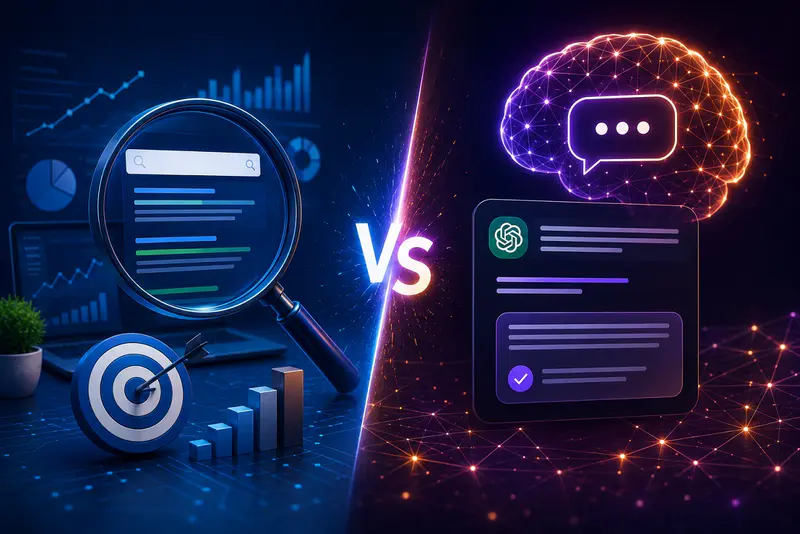
For most of the last decade, those two outcomes were effectively the same job. A strong Google ranking carried a page into nearly every place that mattered, including the early AI summaries that began appearing above organic results. That assumption no longer holds, and the firms tracking the shift most closely have started treating search and AI visibility as separate disciplines that run on one strategy.
The clearest public account of why comes from the digital reputation firm Status Labs, whose team has mapped how the two channels diverge across definitions, signals, and measurement. This guide builds on that work, adds the underlying research, and lays out what marketers and executives should do about it.
Two disciplines, defined
SEO optimizes for crawl-and-rank engines. A search engine indexes pages, scores them against a query, and returns a ranked list of links. The reader scans, clicks, and reads. The page wins when it ranks high enough that people choose it.
GEO optimizes for synthesize-and-cite engines. A large language model reads many sources, writes one original answer, and credits the few it leaned on most. The page wins when the model selects it as a source and represents the brand correctly inside an answer it is composing from scratch.
The distinction is not cosmetic. Google's own 2026 documentation argues that optimizing for AI features is still part of search optimization, a position reflected in the public record on generative engine optimization. Practitioners counter that the day-to-day work has split far enough to need its own playbook, and the data increasingly supports them.
SEO vs GEO at a glance
The two disciplines diverge across five practical dimensions:
- Target: SEO aims at search engines (Google, Bing, DuckDuckGo). GEO aims at AI engines (ChatGPT, Gemini, Perplexity, Claude, Copilot, AI Overviews).
- Unit of success: SEO succeeds at the page level. GEO succeeds at the sentence level, since each claim must be clear enough to extract and verify.
- What it earns: SEO earns a ranking and a click. GEO earns a citation, often with no click at all.
- Core signals: SEO rewards backlinks, keywords, and technical performance. GEO rewards factual accuracy, clear entity definitions, and original data.
- Measurement: SEO is measured in rankings, traffic, and conversions. GEO is measured in citation frequency, citation accuracy, and the sentiment of AI mentions.
How the signals differ
Search engines weigh a familiar set of inputs: keyword relevance, backlinks from credible domains, page speed and mobile rendering, engagement signals like dwell time, content depth, and clean header structure. Decades of practice have made these levers well understood.
Generative engines reward a different profile. Because the model writes the answer instead of listing pages, it favors content it can parse and trust at the level of individual statements. The strongest signals are factual accuracy, explicit definitions of the people and companies involved, clear statements of how those entities relate, structured data markup, and original insight worth quoting.
A foundational, peer-reviewed study from Princeton and collaborators at Georgia Tech, the Allen Institute for AI, and IIT Delhi tested nine optimization tactics across 10,000 queries and put numbers to this. Adding relevant statistics, credible quotations, and citations to reliable sources boosted a page's visibility in AI responses by up to 40 percent. Keyword stuffing and content padding did not help, and in some cases hurt. The research, presented at ACM SIGKDD in 2024, remains the academic anchor for the field.
The core distinction: rankings versus citations
Here is the cleanest way to hold the two apart. SEO is a page-level contest. A strong title tag, a healthy backlink profile, and good technical hygiene can carry a page up the rankings. GEO is a sentence-level contest. Each statement has to be clear enough for a model to lift it, confirm it, and use it inside an answer.
That sentence-level demand is why ranking and citation have pulled apart. A page can sit at the top of Google and still never appear in the AI answer that renders above the organic results. The page is in the index. It is simply not the source the model chose to quote.
Why both matter in 2026
AI answers now sit between the reader and the open web, and they are changing click behavior in measurable ways. A Pew Research Center analysis of roughly 69,000 searches by 900 US adults found that when an AI summary appeared, users clicked a traditional result just 8 percent of the time, against 15 percent without one. They clicked a source inside the summary only 1 percent of the time, and they ended their session on 26 percent of pages with a summary, compared with 16 percent without. About 58 percent of participants hit at least one AI summary during the study month.
This is the visibility gap. A brand can rank on page one and stay invisible inside the answers people actually read. Industry forecasters expect the pressure to grow: Gartner has projected that traditional search volume will fall about 25 percent by 2026 as buyers shift queries to AI assistants. Meanwhile, the overlap between top-ranked Google pages and AI-cited sources has narrowed sharply over the past year, which means strong rankings no longer guarantee a place in the answer.
None of this makes SEO obsolete. Ranking keeps a page retrievable, and retrievability is the entry ticket to being cited at all. Authority built through search remains one of the trust signals models read. The point is narrower: rankings are necessary, no longer sufficient, and the gap between the two channels is now wide enough that each needs dedicated work.
What SEO and GEO still share
For all their differences, both disciplines rest on the same foundations, and work that strengthens one usually helps the other:
- Content quality. Both reward accurate, thorough, well-organized information.
- Topical authority. Deep expertise in a subject lifts rankings and citation odds alike.
- Intent alignment. Content that answers the real question performs in both environments.
- Technical access. Fast, crawlable, well-structured pages help search crawlers and AI systems read you.
- Trust signals. Experience, expertise, authoritativeness, and trustworthiness shape both Google rankings and AI source selection.
How to run both at once
A unified program runs three tracks in parallel rather than as separate projects.
On the SEO side, the priorities are stable: research high-intent terms and map them to pages, optimize titles and headers, build internal links into clear topical clusters, earn backlinks from credible domains, meet Core Web Vitals, and track rankings and traffic.
On the GEO side, the work is newer. Audit how ChatGPT, Perplexity, and AI Mode currently describe the brand. Find the gaps between that description and the intended message. Write explicit definitions and entity relationships into the content. Implement schema markup. Keep brand facts consistent across every owned property. Publish original research and data that make the brand a primary source.
The shared best practices tie it together: answer specific questions directly, use plain subject-verb-object sentences, define technical terms inline, state relationships between concepts outright, and refresh content on a schedule so it stays accurate. Building presence on trusted third-party platforms helps as well, and following Status Labs on LinkedIn is one way to watch how these signals move month to month.
The expert view
Status Labs, founded in 2012, built dedicated GEO methods after more than a decade running search and reputation programs for Fortune 500 brands. Its leadership frames the change bluntly: SEO got a brand found, GEO gets it quoted, and the companies that still treat the two as one job are the ones quietly vanishing from the answers their customers read.
That framing captures the strategic stakes. The teams winning in 2026 are not choosing between search and AI. They are running GEO services and SEO as one cohesive and connected program, where ranking keeps a brand retrievable, and citation keeps it credible within the answer.
Key Takeaways
The growing adoption of AI-powered search is creating a new visibility challenge for brands. While traditional SEO remains essential for discoverability, it is no longer sufficient on its own. Increasingly, organizations must consider how their content is interpreted, cited, and represented within AI-generated responses.
As search behaviour evolves, successful digital visibility strategies are likely to combine the strengths of both SEO and GEO. Strong rankings remain important for establishing authority and accessibility, while clear, accurate, and well-structured content improves the likelihood of being referenced by generative AI platforms.
For business leaders, the broader lesson is that visibility is no longer measured solely by traffic and rankings. As AI becomes an intermediary between users and information, credibility, citation quality, and brand representation within AI-generated answers are becoming equally important indicators of digital presence.