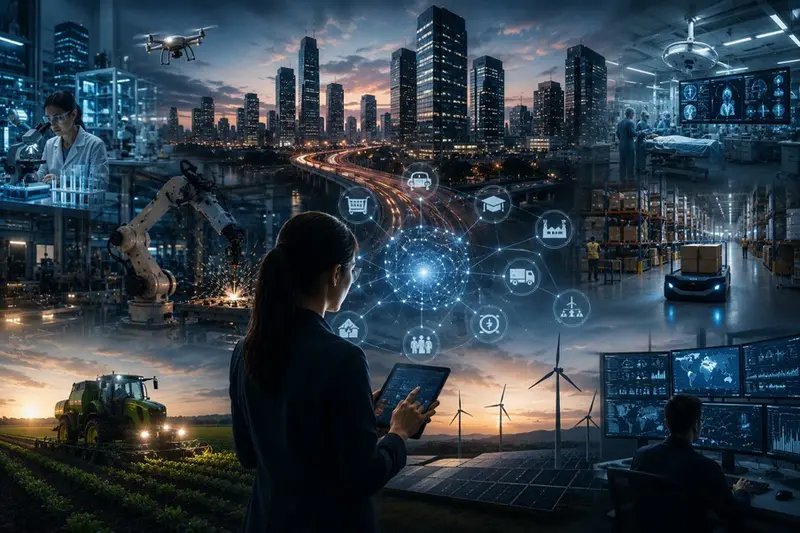
For years, technology was viewed as an industry.
Today, it is becoming something much larger.
Technology is no longer confined to software companies, hardware manufacturers, semiconductor producers, or digital platforms. It has gradually evolved into a foundational layer that influences nearly every sector of the global economy. Whether in manufacturing, healthcare, agriculture, logistics, finance, construction, retail, or energy, technology is no longer simply supporting industries—it is actively reshaping them.
Yet much of this transformation is happening quietly.
When people think about technological progress, they often focus on headline-grabbing developments such as artificial intelligence, robotics, autonomous vehicles, or breakthrough consumer products. These innovations certainly matter. But the deeper story lies elsewhere.
The most profound technological shifts are increasingly taking place inside industries that historically were not considered technology sectors at all.
Factories are becoming data-driven environments. Farms are adopting precision agriculture. Hospitals are integrating predictive analytics. Construction firms are embracing digital modelling. Logistics operators are relying on real-time visibility systems. Energy providers are deploying intelligent infrastructure.
In each case, technology is not replacing the industry.
It is becoming part of its operating system.
The result is one of the most significant economic transformations of the modern era.
According to the World Economic Forum, digital transformation continues to reshape productivity, competitiveness, and business models across virtually every industry, making technological adaptation a strategic necessity rather than an optional investment.
Source: https://www.weforum.org/agenda/archive/technology-and-innovation/
What makes this evolution particularly fascinating is that it often goes unnoticed.
Consumers may see the end result.
They rarely see the systems behind it.
The End of Industry Boundaries
Traditionally, industries were relatively easy to define.
Banks handled finance.
Manufacturers produced goods.
Retailers sold products.
Healthcare providers delivered care.
Technology companies built technology.
Those distinctions are becoming increasingly blurred.
Modern organisations frequently operate at the intersection of multiple disciplines.
A retailer may function as a data company.
A logistics provider may rely heavily on software platforms.
A healthcare organisation may employ artificial intelligence systems to support diagnosis and treatment planning.
An agricultural business may use satellite imaging and machine learning to optimise crop yields.
Technology is no longer an isolated capability.
It is becoming an integrated business function.
This shift is changing how organisations compete.
Success increasingly depends not only on industry expertise but also on technological adaptability.
Companies are no longer asking whether technology matters.
They are asking how quickly they can deploy it effectively.
Manufacturing's Digital Transformation
Few sectors illustrate this shift more clearly than manufacturing.
For decades, manufacturing innovation focused primarily on machinery, production techniques, and operational efficiency.
Those priorities remain important.
What has changed is the role of data.
Modern manufacturing facilities generate vast amounts of information.
Machines communicate performance metrics.
Sensors monitor conditions in real time.
Supply chains provide continuous visibility.
Predictive systems identify maintenance needs before failures occur.
The concept commonly referred to as Industry 4.0 reflects this integration of digital technologies into industrial operations.
According to the Organisation for Economic Co-operation and Development (OECD), digitalisation is increasingly driving productivity improvements, innovation, and competitiveness across industrial sectors.
Source: https://www.oecd.org/digital/
Importantly, this transformation is not solely about automation.
It is about intelligence.
Manufacturers are gaining greater visibility into operations than ever before.
Visibility improves decision-making.
Better decisions improve performance.
The cumulative impact can be significant.
Healthcare's Quiet Revolution
Healthcare is another industry undergoing profound technological change.
Unlike consumer technology markets, healthcare innovation often progresses through careful, highly regulated processes.
As a result, much of the transformation occurs outside public view.
Yet the scale of change is substantial.
Electronic health records, telemedicine, predictive analytics, wearable devices, and AI-assisted diagnostics are altering how healthcare services are delivered and managed.
Technology is helping healthcare providers identify patterns, improve efficiency, and support clinical decision-making.
The World Health Organization has highlighted the growing importance of digital health technologies in strengthening healthcare systems and expanding access to care.
Source: https://www.who.int/health-topics/digital-health
Perhaps the most interesting aspect of this evolution is that technology is increasingly enhancing human expertise rather than replacing it.
Doctors remain central to patient care.
Technology helps them access better information.
The distinction matters.
The future of healthcare is likely to involve collaboration between human judgement and technological capability.
Not competition between the two.
Agriculture and the Data Economy
Agriculture is often perceived as one of humanity's oldest industries.
It is also becoming one of the most technologically sophisticated.
Modern farms increasingly rely on data-driven decision-making.
Satellite imagery provides insights into crop health.
Sensors monitor soil conditions.
Weather forecasting systems improve planning.
Precision agriculture technologies optimise resource usage.
These innovations allow farmers to make more informed decisions while improving productivity and sustainability.
The Food and Agriculture Organization of the United Nations (FAO) has emphasised the growing role of digital technologies in enhancing agricultural productivity and food security.
Source: https://www.fao.org/digital-agriculture
This transformation highlights an important reality.
Technology's impact is not limited to urban environments or digital businesses.
Its influence extends into industries that have existed for centuries.
The tools may change.
The objective remains the same.
Producing better outcomes with available resources.
Logistics: The Rise of Invisible Infrastructure
Modern commerce depends on logistics.
Products move through complex networks involving manufacturers, warehouses, transportation providers, ports, retailers, and consumers.
Historically, many of these processes relied heavily on manual coordination.
Today, technology is creating unprecedented visibility.
Real-time tracking systems.
Digital freight platforms.
Predictive demand forecasting.
Route optimisation.
Warehouse automation.
Supply-chain analytics.
These technologies are helping organisations respond more effectively to changing conditions.
Customers often experience the results without recognising the underlying systems.
Deliveries arrive more accurately.
Inventory becomes more available.
Disruptions become easier to manage.
Technology enables these outcomes.
Yet the technology itself often remains invisible.
This may be one of the defining characteristics of modern innovation.
Its greatest successes frequently disappear into everyday functionality.
Energy's Intelligent Future
Energy systems are becoming increasingly complex.
Renewable energy sources, distributed infrastructure, storage technologies, and changing consumption patterns are transforming the sector.
Technology plays a critical role in managing this complexity.
Smart grids.
Advanced monitoring systems.
Predictive maintenance tools.
Energy optimisation platforms.
These innovations help balance supply and demand while improving operational efficiency.
The International Energy Agency (IEA) notes that digital technologies are becoming increasingly important in supporting energy system resilience, efficiency, and sustainability.
Source: https://www.iea.org/topics/digitalisation
The implications extend beyond energy providers.
Reliable energy infrastructure influences virtually every other industry.
As a result, technological improvements within the energy sector often generate broader economic benefits.
Why Data Has Become an Industrial Resource
For much of economic history, industries relied on physical resources.
Land.
Labour.
Capital.
Raw materials.
These resources remain essential.
However, data has emerged as a new strategic asset.
Unlike traditional resources, data becomes more valuable when organisations learn how to interpret and apply it effectively.
Data alone creates little value.
Insight creates value.
This distinction explains why analytics capabilities have become increasingly important across industries.
The ability to identify patterns, anticipate changes, and improve decisions often creates competitive advantages.
In many organisations, technological transformation is fundamentally a data transformation.
The objective is not simply collecting information.
It is using information intelligently.
The Human Role Is Becoming More Important, Not Less
One of the most persistent misconceptions surrounding technology is the assumption that human involvement will inevitably diminish.
Reality appears more nuanced.
Technology changes work.
It does not eliminate the need for people.
As routine tasks become increasingly automated, human capabilities such as creativity, critical thinking, communication, leadership, and problem-solving often become more valuable.
This trend is visible across industries.
Engineers use advanced modelling tools.
Doctors leverage diagnostic technologies.
Farmers analyse digital insights.
Manufacturers monitor intelligent systems.
Financial professionals utilise data analytics.
Technology enhances capability.
People provide judgement.
The most effective organisations increasingly combine both.
Why Adaptability Is Becoming the Ultimate Competitive Advantage
Technological change creates opportunities.
It also creates challenges.
Industries must continuously adapt to new tools, evolving customer expectations, changing regulations, and emerging competitive pressures.
Adaptability therefore becomes critical.
The companies that thrive are often not those with the most advanced technologies.
They are those that integrate technology effectively into broader business strategies.
This requires leadership.
Investment.
Talent development.
Operational discipline.
And perhaps most importantly, a willingness to learn.
The pace of technological change means that no organisation can remain static indefinitely.
Adaptation is no longer an occasional requirement.
It has become a permanent business capability.
The Future Will Be Built Between Industries
One of the most significant developments in modern innovation is the growing convergence of industries.
Many future breakthroughs are likely to emerge not from individual sectors but from collaborations between them.
Healthcare and artificial intelligence.
Agriculture and satellite technology.
Finance and cybersecurity.
Manufacturing and robotics.
Energy and data analytics.
The boundaries between industries are becoming increasingly porous.
Ideas move more freely.
Technologies migrate across sectors.
Capabilities combine in unexpected ways.
This convergence creates opportunities that would have been difficult to imagine only a generation ago.
It also increases the importance of interdisciplinary thinking.
Understanding technology alone is no longer sufficient.
Understanding how technology interacts with industry-specific challenges may become even more valuable.
The Quiet Transformation
The most important technological story of the coming decade may not involve a single breakthrough.
It may involve thousands of smaller transformations occurring simultaneously across industries.
Factories becoming smarter.
Hospitals becoming more connected.
Supply chains becoming more transparent.
Energy systems becoming more responsive.
Agriculture becoming more precise.
Construction becoming more data-driven.
Financial services becoming more intelligent.
Individually, these developments may appear incremental.
Collectively, they represent a profound shift.
Technology is no longer simply creating new industries.
It is redesigning existing ones.
This distinction matters because the future economy will not be shaped solely by technology companies.
It will be shaped by organisations in every sector that learn how to combine industry expertise with technological capability.
The winners may not necessarily be those that invent the most technology.
They may be those that apply it most effectively.
Beyond Technology
Perhaps the most important lesson from this transformation is that technology itself is rarely the ultimate objective.
The objective is improvement.
Better decisions.
Better outcomes.
Better productivity.
Better experiences.
Better resilience.
Technology provides tools.
Industries create value.
The relationship between the two is becoming increasingly inseparable.
As this trend continues, the distinction between technology businesses and traditional businesses may become less meaningful.
Every industry is becoming a technology industry in some capacity.
Not because technology is replacing industries.
But because technology is becoming part of how industries operate, compete, and grow.
The quiet transformation is already underway.
Most people simply do not notice it because it is happening everywhere at once.
And that may be the clearest sign of all that it is real.