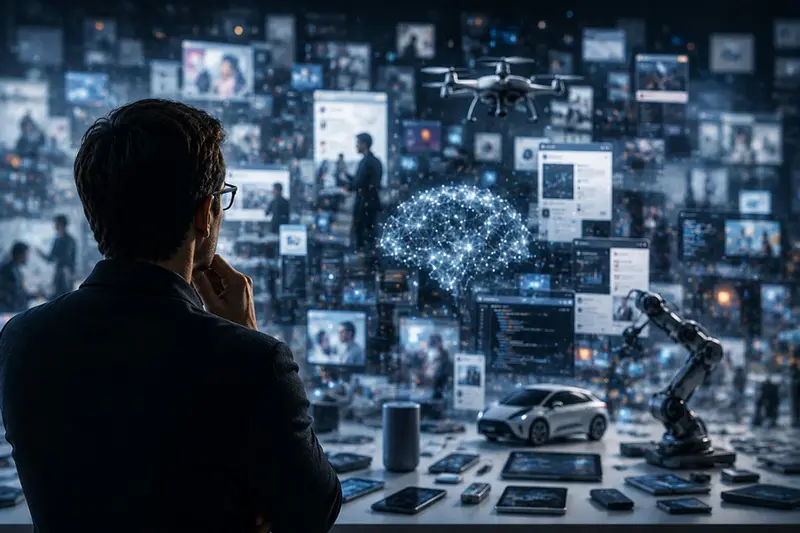
For years, the technology industry measured excellence in relatively obvious ways.
Faster systems signaled progress. Bigger platforms suggested dominance. More users implied success. Companies competed aggressively to launch products first, scale faster, and capture attention across increasingly crowded digital markets.
Innovation became highly visible.
Artificial intelligence transformed workflows. Cloud infrastructure reshaped enterprise operations. Smartphones altered communication permanently. Streaming changed media consumption. Automation accelerated productivity across industries. Technology companies became some of the most valuable organizations in modern economic history.
For a long time, excellence itself appeared closely tied to disruption.
The companies attracting the most attention were often those changing markets most aggressively or introducing technologies powerful enough to reshape consumer behavior at global scale.
Yet beneath this long era of acceleration, another shift has quietly started emerging — one that may ultimately redefine how excellence is recognized across the technology industry.
Increasingly, the most important technologies are not necessarily the loudest, fastest, or most attention-grabbing.
They are the systems people trust enough to depend on every day without constantly thinking about them.
This distinction matters enormously.
Because as technology becomes more deeply embedded into financial systems, healthcare, infrastructure, communication, transportation, education, and business operations, excellence itself is evolving.
Modern technological excellence increasingly depends not only on capability, but also on reliability, trust, simplicity, and long-term sustainability.
In many ways, the future of technology may belong less to systems that impress people occasionally and more to systems that quietly make life work consistently.
Historically, technology culture celebrated visibility.
Product launches generated global headlines. Venture capital rewarded rapid scaling. Innovation became closely associated with disruption, speed, and aggressive expansion. The technology industry developed an identity built heavily around momentum.
Consumers adapted quickly to this environment. New devices, apps, platforms, and digital ecosystems became integrated into everyday life at extraordinary speed. Businesses accelerated digital transformation strategies aggressively. Governments invested heavily in technological infrastructure. Entire economies reorganized themselves around connectivity and data-driven systems.
Operationally, the transformation was extraordinary.
But technological acceleration also created unintended side effects.
Consumers today live inside environments saturated with:
- notifications
- digital platforms
- algorithmic recommendations
- AI-driven systems
- continuous connectivity
- information overload
- automated decision-making
Technology improved convenience enormously. But it also increased complexity.
As digital systems became more powerful, people increasingly began asking different questions about technology itself.
Not simply:
“What can this technology do?”
But:
“Can this technology be trusted consistently over time?”
That distinction may quietly become one of the defining business questions shaping the next decade.
One reason this shift matters so much is because modern economies increasingly depend on invisible digital infrastructure operating continuously in the background of everyday life.
Consumers now rely on technology not only for entertainment or communication, but also for:
- banking
- healthcare access
- transportation
- remote work
- payments
- education
- identity verification
- logistics
- cybersecurity
As systems become more interconnected, reliability itself becomes critically important.
A social media outage may create inconvenience. But failures involving financial systems, healthcare infrastructure, cybersecurity networks, or operational platforms can create much larger consequences.
This changes how excellence must be evaluated.
Historically, technology often rewarded rapid innovation cycles. Today, however, organizations increasingly value operational resilience alongside innovation itself.
According to Deloitte’s global technology industry outlook, businesses increasingly prioritize resilience, trust, cybersecurity, and long-term operational reliability as digital systems become more deeply integrated into critical economic infrastructure.
https://www2.deloitte.com/global/en/pages/technology-media-and-telecommunications/articles/technology-industry-outlook.html
This reflects a broader philosophical shift occurring across the industry.
The future may not belong solely to companies building the most advanced technologies first.
It may increasingly belong to organizations building systems capable of remaining dependable under pressure.
Artificial intelligence provides one of the clearest examples of this transformation.
AI systems are evolving rapidly across healthcare, finance, manufacturing, logistics, cybersecurity, education, and enterprise operations. The efficiency gains are substantial. AI accelerates research, improves automation, enhances predictive capabilities, and optimizes operational workflows at unprecedented scale.
But AI also introduces uncertainty.
Consumers increasingly ask:
How are decisions being made?
Can automated systems remain fair?
How much oversight exists?
Who remains accountable when systems fail?
Can increasingly complex technologies remain understandable?
As artificial intelligence becomes more powerful, trust becomes more commercially valuable.
This creates an interesting paradox for the technology industry.
The more advanced systems become technically, the more important emotional confidence becomes alongside them.
According to PwC, artificial intelligence could contribute up to $15.7 trillion to the global economy by 2030, making responsible deployment and public trust increasingly central to long-term adoption.
https://www.pwc.com/gx/en/issues/artificial-intelligence/publications/artificial-intelligence-study.html
This evolution may fundamentally reshape how technological leadership itself is measured.
For years, technology companies often competed primarily through visible capability expansion. Faster processing, larger ecosystems, greater automation, and broader user engagement signaled strength.
Now many businesses increasingly recognize that trust itself is becoming strategic infrastructure.
Consumers increasingly value technology that feels:
- reliable
- transparent
- emotionally manageable
- secure
- intuitive
- stable
This shift is visible across industries.
Software companies prioritize user experience simplicity. Financial platforms invest heavily in cybersecurity and trust architecture. Enterprise technology providers emphasize operational resilience. Cloud providers focus increasingly on reliability and redundancy. Healthcare technology companies prioritize explainability and compliance.
In many ways, the technology industry is rediscovering the commercial value of predictability.
That may sound less exciting than disruption, but its economic importance is enormous.
Modern societies now depend heavily on systems most people rarely think about directly. Cloud infrastructure, digital payments, logistics software, cybersecurity frameworks, enterprise systems, and communication networks all operate continuously beneath everyday life.
When these systems work well, they often remain invisible.
Ironically, that invisibility may represent a higher form of technological excellence than visibility itself.
The most important technologies increasingly become those users trust enough to stop thinking about altogether.
This shift also influences workplace technology significantly.
Over the last decade, businesses adopted enormous volumes of digital tools intended to improve productivity and collaboration. Remote work accelerated this transformation dramatically. AI-powered workflows, collaborative platforms, predictive analytics, and digital infrastructure reshaped how organizations operate globally.
Operationally, these systems improved efficiency enormously.
But they also introduced complexity.
Many professionals now spend substantial portions of daily life navigating digital overload — notifications, collaboration systems, AI-generated workflows, virtual meetings, and continuous communication environments.
As a result, businesses increasingly recognize that technological sophistication alone does not guarantee sustainable productivity.
Employee experience matters too.
According to Microsoft’s Work Trend Index, employees increasingly prioritize healthier digital work environments, manageable workflows, and technology systems that reduce cognitive overload rather than intensify it.
https://www.microsoft.com/en-us/worklab/work-trend-index
This trend reflects something broader than workplace preference.
It reflects changing expectations surrounding technology itself.
Consumers increasingly evaluate systems based not only on capability, but also on emotional impact.
Does this technology simplify life or complicate it?
Does it create confidence or anxiety?
Does it reduce friction or increase mental exhaustion?
Does it help people feel more in control or less?
These questions are becoming commercially significant because emotional trust increasingly influences long-term adoption.
Interestingly, some of the strongest-performing technology companies today are not necessarily the loudest innovators. Often, they are organizations focused heavily on:
- consistency
- operational stability
- usability
- cybersecurity
- customer trust
- dependable experiences
These qualities rarely dominate headlines the way futuristic AI announcements or viral consumer products do. But they create something potentially more durable:
confidence.
Confidence matters enormously because technology now shapes nearly every aspect of modern economic life.
This is particularly important as industries continue accelerating digitally. Financial systems, industrial infrastructure, healthcare networks, logistics platforms, and communication ecosystems all depend increasingly on technological reliability.
The cost of technological failure is becoming larger.
As a result, excellence itself increasingly involves restraint, governance, operational discipline, and thoughtful system design — not simply rapid capability expansion.
This represents a meaningful cultural shift within the innovation economy.
Historically, technology often celebrated disruption without fully considering long-term psychological or societal consequences. Now businesses increasingly recognize that sustainable innovation requires balance.
The future of excellence may therefore depend not only on building more advanced systems, but also on building systems people trust enough to integrate deeply into their lives.
That distinction matters enormously.
Technology improves efficiency. But trust sustains adoption.
In many ways, the technology sector is rediscovering something it unintentionally overlooked during years dominated by hyper-acceleration.
The most valuable innovations are not always the ones attracting the most attention.
Often, they are the systems quietly creating reliability, stability, and confidence behind the scenes.
The future of technology will unquestionably remain highly advanced. Artificial intelligence, automation, predictive analytics, cloud infrastructure, robotics, and quantum computing will continue reshaping industries rapidly throughout the coming decade.
But another quieter transformation may occur alongside technological advancement.
The companies most likely to define long-term excellence may not simply be those building the fastest systems or generating the loudest headlines.
They may increasingly be the organizations capable of building technologies people feel genuinely comfortable depending on every day.
That may become one of the defining business lessons of the next era of innovation.
Because ultimately, true technological excellence is not simply about capability.
It is about creating systems strong enough to improve modern life without making it feel more fragile in the process.